Thursday, April 9, 2015

Day One of DR: The Pilot Study


We’ve officially finished the first part of the program and are now headed full tilt into Directed Research! I mentioned this in my first post, but the School for Field studies has Five Year Plans at each of their sites. The Five Year Plan is a large, on going research project that, well, lasts for five years! Each DR project is a small component of the Five Year Plan. The overarching question for the East Africa Five Year plan is:

            How can changes in land use and resource availability in the Maasai steppe of Kenya       and Tanzania be managed in such a way as to foster the well-being of local communities whilst safeguarding and promoting biodiversity conservation?

My DR is studying the contribution of beekeeping to household income and poverty alleviation in two villages, Ayalaliyo and Kambi ya Faru. There are six other students studying other various aspects of beekeeping as well. We all work as a team interview local people and then we will write separate papers.
            Today was our “Pilot Study” where we tested out the questionnaires and data sheets that we created. Ours was a little stressful because we only started making the questionnaires this morning, so it felt like very little time to put together a nice, cohesive group of questions. It all ended up OK though, since the pilot study is all about seeing how the questionnaires worked and giving us opportunities to change the questionnaires.
            In the early afternoon, we headed out to Ayalaliyo, which is about an hour and a half away from Rhotia. I had heard from several people that the Enderbash region, where Ayalaliyo and Kambia ya Faru were located, was stunningly beautiful with farmland and rolling hills. My expectations, however, were completely blown away. These villages are way up in the Karatu highlands, and the valleys, forests, rich farmland, and distant vista views made it the most beautiful place I’ve visited in Tanzania. Even the red soil was beautiful to look at—it was flecked with gold mica and vaguely glittered in the light. It sounds like I’m making that up, but it’s really true!
            We had three guides and were split up into three groups. We walked around the hilly countryside, looking for households to interview. When we do interviews, we basically just walk into someone’s yard and call Hodi, which doesn’t really have a translation, but it’s kind of announcing that you’re there and asking to come in. After our guide/translator explains why we’re there, people usually invite us into their houses and under a shady tree. Most people are quite open and friendly. The interviews are translated from English to Swahili or the local language. A lot of people weren’t home, but we did meet one woman (who was the wife of one of the askari- guards- here at camp) who kept bees. It was really hard to get some of the questions across (especially mine about specific costs and then the ones trying to get at non-use values were pretty much impossible), but hopefully we will be able to work out the kinks. We only had to do two interviews per group, but that was still pretty exhausting.
            DR is going to be something quite new for all of us. We’re all split up into different groups and we spend the whole day outside of camp. But what we’re doing is very exciting, and at the end, we get to present it all to the community. Apparently, presentation day is a day of festivities, with presentations and then lunch for the whole community.
            I was quite pleased to find out that a lot of these projects were created after officials from different organizations asked our professors to look into certain issues. For example, one group is researching wild dogs in Tarangire and the surrounding area because officials from Tarangire National Park asked our wildlife management professor to look into the wild dogs there. My group is doing beekeeping because officials from Karatu asked our policy professor to investigate beekeeping and its benefits in a region where that was not well studied.
            So now we have nine more days of intense fieldwork and then we’ll be less than a month away from our departure date. :( It is coming up way too fast!!

Oh, and highlight of the day:


Mwamhanga, our policy professor, giving us a lecture that went from following your passions instead of expecting that a degree was going to make you happy to how to get over your boyfriend or girlfriend cheating on you. It was great.

Tuesday, April 7, 2015

Serengeti Pictures


We spent the first morning of expedition in the Ngorongoro Crater. This beautiful caldera is over 200 square kilometers and holds a glorious community of all sorts of animals.


There were lots of spotted hyenas running around the crater. Also lots of wildebeest and zebra.


Pictures and words can in no way capture the magnificence of the caldera cliffs rising up around you from all sides.


The crater is full of animals that are rare to see in other places, even the national parks. These super muscular antelope are eland. We've seen them maybe three other times outside of the crater.


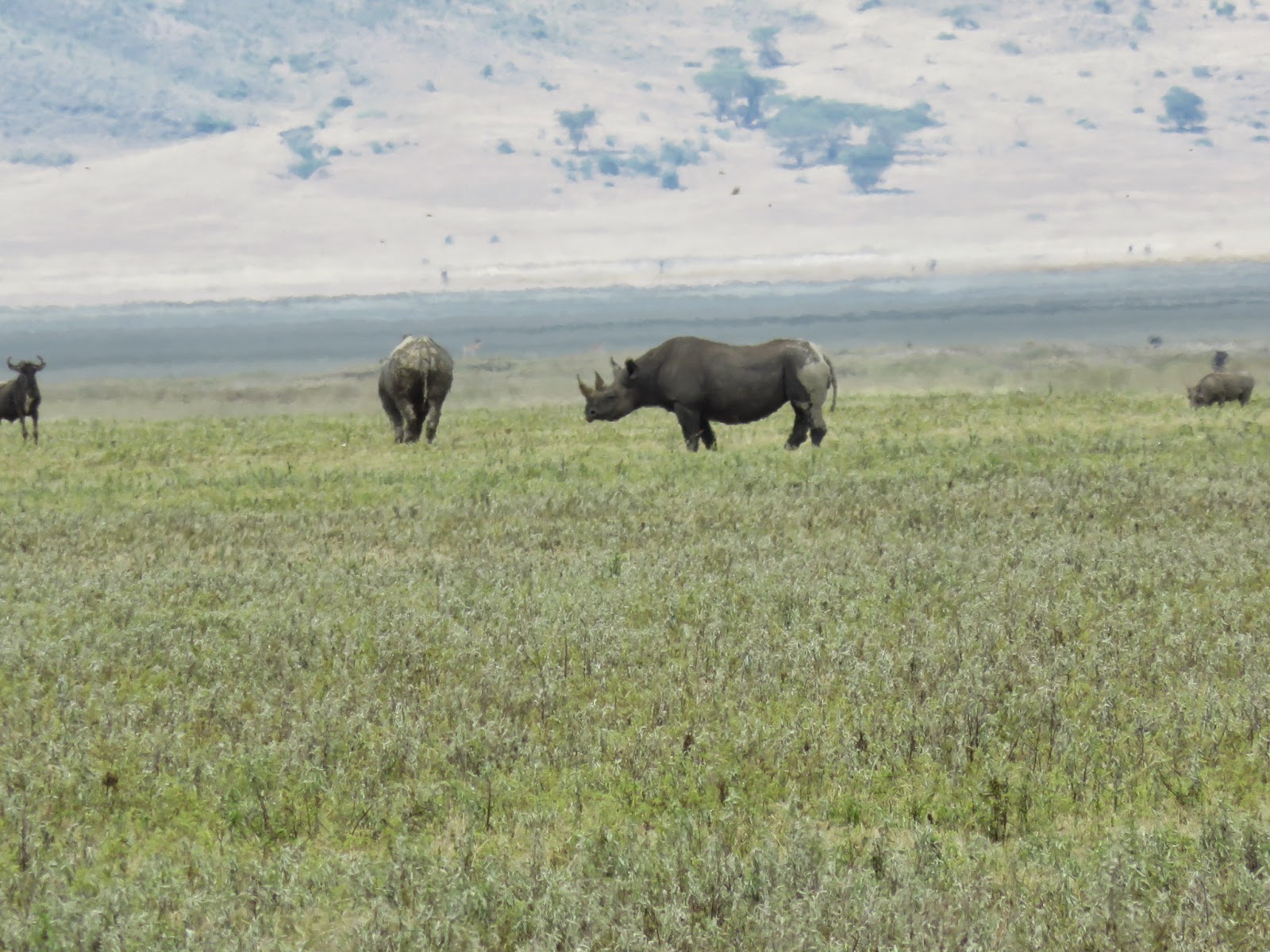
Estimates say there are less than 100 black rhinos left in the world. Of the remaining black rhinos, about thirty live in the Ngorongoro Crater. We were lucky to see four of these guys, and one was a baby!


And something even rarer than a rhino… a unicorn!


(OK, actually just a Thompson's Gazelle with one horn)


On our way out of the Crater, one of the cars was lucky enough to see a pride of lions trying to take down a male buffalo! The buffalo got away, however, because one of the other buffalo turned back and chased off the lions! Our professors had never heard of anything like that happening. I didn't get to see the chase, but I did get to see the lionesses.


The afternoon turned stormy in the crater, but its so big that half of it would be covered in storm clouds and the other half would be slightly sunny. This picture can't really capture the beauty of the sunlight playing on the caldera's sides while a rain storm was blowing through the middle of the crater.


Driving to our campsite in the heart of Serengerti National Park! From the Ngorongoro Crater it was about a two and a half hour drive to the Nabi Gate of Serengeti and then another two and half hours to our campsite. The main road was a very rough gravel road and the side roads to the campsite were mud. Mudding was super fun, not going to lie.


I didn't take any pictures of our campsite, but I have to explain about it because it was the coolest campsite ever. Being in the heart of the Serengeti meant being surrounded by wildlife both during the day and at night. We had askari (guards) to escort us around the camp at night because buffalo, hyena, zebra, baboon, and lion wandered around. During a night time trip to the bathroom, it was pretty likely that you'd see a buffalo or a hyena. The scariest part, however, was the safari ants. These are ants that typically form thick lines on the ground and if you step in that line... pole sana (very sorry). They swarm you and then start biting you. Luckily, it's pretty easy to step over the lines of ants, but one night there was a huge mass of them in front of all of our tents, so it was impossible to get through for about 30 minutes. One tent had the unfortunate experience of a safari ant line forming inside their tent. After bravely trying to hold their ground, they had abandon their tent and find other tents to sleep in that night. Thankfully, I did not have any bad experiences with the safari ants. OK, on to more pictures!


A cheetah in the Serengeti.


There weren't too many giraffes that we saw in the Serengeti, but the ones we did see were a lot less skittish around humans than the ones in Tarangire and Lake Manyara NPs.


We saw so many lions! We also watched lots of lions because one of our assignments was to observe how much tourists value different wildlife species. We did this through recording how long tourists cars would watch an animal (or if they didn't stop to watch at all). Tourists stayed the longest with lions and leopards, so we spent many hours lion and leopard watching.


Life is so hard when you're a lion in the Serengeti.


Disney wasn't lying when they depicted Simba as a cub who was always jumping on his parents and bugging them to go play. This female cub would jump on her sleeping pride mates left and right, trying to get them to play. Usually the older lions shoved her in the direction of the yearling lions, who willingly wrestled with this ball of energy (when they weren't sprawled out like the guy in the picture above).

There was a very popular spot where a leopard had a den with two cubs. There were always at least seven or six (if not 30) tourists cars in that area, which was really annoying to be around. I only got a glimpse of the cubs (and no pictures), but… I was lucky enough to see another leopard get chased out of her tree by a troop of baboons. She walked alongside the road for quite a bit. Leopards are usually pretty rare to see, especially out of their trees!


A beautiful topi. Their coloration is gorgeous.


Dikdiks are adorable. They are quite tiny and they mate for life so you always see them in pairs.


The clouds were one of my favorite parts of the Serengeti. You could watch them go from fluffy cumulus in the morning, to cumulus congestus by lunch time, and then impressive cumulonimbus by sunset. At sunset during our drives back to camp, the clouds had just started to form their anvils, and only the very tops would be lit up by the remaining sun.


It isn't a complete trip to the Serengeti during the wet season unless you get stuck in the mud at least once. This was right after our ecology professor got his car out of a muddy hole in spectacular fashion.


The whole group has some spectacular stories from the expedition. On top of seeing leopards, cheetahs, and lions, we also saw a serval and a caracal. Both are smaller wild cats and pretty unusual to see, but caracals are especially rare. We also saw lions hunting wildebeest, though the lions were unsuccessful. We also identified over 60 species of birds, learned that you should never open the roofs before you move the car the morning after it has rained (you'll get very wet if you do), tried to pull some very unsuccessful pranks on April Fools day, and had the chance to stuff ourselves with dessert and cheese when we visited the Serena Lodge for an afternoon.

On our way back from Serengeti, we stopped at Oldupai Gorge, the place where some of the oldest fossils of early human ancestors, from Homo habilis to early Homo sapiens, have been found. Early human tools have also been found, as well as fossils of early predecessors to modern African animals. There was a skull of an extinct antelope that was almost the size of an elephant!! We were given a short lecture and then a chance to look around the small museum. It was cool to look at the gorge, which has been shaped by long gone rivers and multiple volcanic eruptions from millions of years ago.

It was almost sad to get back to Moyo Hill. Expedition had been amazing, and nobody wanted to start thinking about finals. We were given one day to study for Ecology, had our Ecology exam the next day. We had a non-program day on Sunday, which I spent exploring cool restaurants in Karatu and studying. I also went to a Lutheran church in Rhotia for their Easter services. I didn't understand most of it, but it was nice to hear some of the hymns.  On Monday we had another study day, and today (Tuesday) we took our Wildlife Management Exam and are now studying for our last exam, Environmental Policy. Exams aren't too bad, but kind of daunting because they're worth 50% of our grade… After Wednesday, however, Directed Research projects start. Hopefully I will be able to write another post soon about my Directed Research. Here's a sneak peak: I'm studying the contribution of beekeeping to household income and poverty alleviation in the Karatu District. Econ and enviro in one. I'm so excited!

Between the Tarangire and Serengeti Expeditions

There were many things that happened in the three weeks between the Tarangire Expedition and the Serengeti Expedition. One of the main projects was a study on cultural tourism. We also picked our Direct Research topics, took our last trip to Lake Manyara National Park, and finished all of our class lectures. Right after Serengeti was when our exams began!


Our last trip to Lake Manyara National Park was bittersweet. I really liked traveling around this park, because you could go from forest to flat grassland to woodland to marsh in the course of half of a day. And with this variation in habitat came a great variation in animals. Even though the chances of seeing a cheetah, leopard, or lion were close to none, watching all of the other animals was always really fun. There was also no pressure to rush to the "cool spot" where the big carnivores were, so you could just drive around and feel relaxed. The landscape was also breathtaking, with the gorgeous escarpment of the Great Rift Valley always a presence either on the horizon or right next to you, if you were driving alongside the edge of the park.


Wildebeest have become one of my favorite animals here. Don't they look so cool? And the noises they make. They sound like aliens! 


One of my favorite parts of these three weeks was the study of cultural tourism. We got to go around and experience different tribes' tourist programs, but we were secretly undercover wanafunzi (students) collecting data on whether cultural tourism is a viable economic, ecological, and cultural tool for these tribes. We visited two tribes, the Hadzabe and the Maasai. For the Maasai, we were split into three groups and each group went to a different boma (Maasai household). The group I was with definitely had the best experience out of everyone. I was pretty skeptical at first because they dressed us up in the traditional Maasai shukahs (colorful cloths) and then, after their welcoming dance, they put a lot of their beads and necklaces on us. It felt like we were playing dress up. 


We did get to watch the men dance (it's where they sing and then see who can jump the highest) and then the Maasai women and us hugged the man whom we thought jumped the highest. That was kind of weird. Then we fetched water with them, walking along the main road… dressed up like Maasai. I felt so weird. When we got the water, all of the people (they were all Tanzanian) were laughing at the mzungu (white people) Maasai and taking pictures of us. Not in a mean way, it was just obviously a very weird thing. After that, the Maasai women showed us how to patch the houses. Their houses are made out of a frame made from sticks and then a mixture of water, dirt, and cow dung spread over the sticks. We got to spread the mud and cow dung mixture over their house, which is harder than it looks! 

Next, we collected firewood with the mamas (women), but this is where it started to get really cool. There were a couple of Maasai men who could speak very good English. One of them came with us to get firewood and he would jump out from behind bushes and make wild animal noises, trying to scare us in a very big brotherly way. That started to get fun, and even though the mamas couldn't speak English and we couldn't speak Maa, we all had a good time swinging machetes and laughing whenever someone's shukah got stuck in a thorny bush. After that, it felt like we were all a lot more comfortable with each other. 

We got to learn about their houses, learn about their medicine and watch them brew a medicinal soup of some kind of tree root and animal meat. We bought some of the jewelry the mamas had made, and then we got to learn how to make the beaded jewelry with the mamas. We all sat under a tree on cow skins and beaded. It was great! And our "big brothers" were also there, joking and talking with us.


At the very end, they offered us some of the medicine, first without the meat. We all tried it, perhaps foolishly (the medicine had been boiled and everything), but don't worry, no one got sick. (Disclaimer: Usually we're all very careful about what we eat and where we eat it. I haven't gotten sick once. *Knocks on wood*) The medicine was blood red and tasted very bitter. Then they added the meat to it and offered it to us, but we all declined that. We also got natural toothbrushes made for us out of the acacia tree we were standing under. That was really cool!

 When we were leaving, the mamas motioned us over and gave us some free bracelets that we had been working on. And then, since nobody wanted to leave, we all got into a big circle and did a spontaneous dance to a Maasai song. They wanted us to sing an American song, but we couldn't decide on one! After that, we had to leave, with many an asheneling (thank you very much in Maa). In the end, it felt like we were all friends, and I know all of us want to go back and visit these people again. 

Ultimately, though, we were there for an assignment, and had to use the information we collected for discussions of cultural tourism. While the people of this boma managed to diffuse the tension and awkwardness of mzungu coming to watch them live their daily lives like it was a living museum or something, we still had to remember that this was most likely an act and that for many of the people, cultural tourism is a way to make a very meager amount of money. In most cases, tour agencies or other third parties get the majority of the money generated by cultural tourism, and the actually communities only get a few thousand shillings. 

For the Hadzabe, the other tribe we visited, the differences in income for different parties was striking. The Hadzabe are the last hunter-gather tribe still living in Tanzania. They live on a game reserve where they are allowed to freely hunt. At the gate of the game reserve, we payed $100 US dollars, our guide (who wasn't even Hadzabe) got 60,000 Tanzanian Shillings (about $34) and the Hadzabe got 30,000 TSH (about $17) to split among the community. They showed us how to make fire without matches.

They also showed us how to shoot their bows and arrows. It was much harder than the bows and arrows I was used to from camp. The string was much harder to pull back. They were all very good shots. Us students, not so much, but we did have an awesome time trying!
                                                                                                                                      
We also got to hear them play one of their musical instruments, which was a bit like a two stringed viola/violin with a small bow. You held it on your side and outwards. It worked through harmonics, which was really cool! I played it and managed to figure out a few notes. It felt so good to play a musical instrument! We also did a dance with them and then bought some of the jewelry the women had made. This experience definitely felt more "touristy" and "showy" than the Maasai experience. I think a lot of that had to do with the language barrier and having an actual guide show us around.


For my paper, I wrote about how community-based tourism, which gives communities more ownership of the land they live on, might be an alternative to cultural tourism. While I still can't say for sure if cultural tourism is bad for cultures (is it exploitation? Do they actually have a choice? Does it help preserve the culture or does it influence the culture in negative ways?), I suggested that more ownership of the land will both provide incentive for conservation and provide better sources of income. For example, communities could allow lodges to be built on their land and then get revenue from those lodges. Currently in Tanzania, locals do not actually own the land they live on and wild animals are government property. Because local people usually incur costs only from these animals, there is no incentive to protect them. There are some governmental programs that can transfer some of these land use rights to the community, including Wildlife Management Areas. WMAs are areas that the community creates management plans for, and, if it is approved by the government, essentially becomes a conservation area run by local communities. Community involvement in conservation is very important for Tanzania if their national conservation plans are going to succeed. 

Tarangire Pictures

I have just finished my Wildlife Management final exam and have a bit of time before continuing with my studying for my Enviro Policy exam tomorrow, so I thought I'd take this opportunity to finally update my blog. It's been pretty busy recently. The last time I updated I had just come back from our five day overnight Tarangire expedition where we camped about 15 minutes way from Tarangire National Park. Tarangire itself is about an hour and a half away from our camp at Moyo Hill and it is an important part of the Tarangire-Manyara Ecosystem that SFS studies in. It is much larger than Lake Manyara National Park, but the habitat is not quite as varied as LMNP. Many animals migrate between the two parks, and also beyond, to Lake Natron and Serengeti. The area between the two parks is an important wildlife corridor, but it is also important grazing land for the Maasai, so human-wildlife conflict is an extensive issue.

Expedition was amazing, despite the hot temperatures and burrs that took over EVERYTHING in our camp. Still, I'd rather deal with the burrs than the safari ants (more about those coming up in my Serengeti post).

I have a lot of things that I could talk about, so I'm just going to post pictures of the highlights!


The beautiful scenery of Tarangire National Park.


There are so many elephants in Tarangire!! On the second day of expedition we were given an academic assignment to watch at least five elephant groups and record how many males, females, and young there were. We also recorded major activities, body condition, and stress level, which was determined secretions from the temporal glands. Most elephants in Tarangire had good body conditions, but most had temporal gland secretions, indicating that there was some kind of stress for them. This might have been the late rains for the rainy season. It was supposed to start raining in mid-February, but it hadn't even started raining yet at the beginning of March. It finally started raining consistently (at least here at Moyo Hill) about a week and a half ago.


There were so many baby elephants. They were so adorable and had no clue what to do with their trunks!


One of the coolest things we saw was a group of elephants mourning over a relative's bones. It is well-known that elephants grieve the loss of group and family members (group members usually are family members), but actually seeing it happened was chilling. They would pick up the bones with their trunks and caress the skulls (shown here). Even the littlest elephants joined in.


At the end of the first day we saw our first big cat!!! A cheetah!


We also saw African Wild Dogs, which is a species that is locally extinct in most areas. This group must have just moved into Tarangire, because before they were thought to be gone from the area. It was the first time SFS students had seen wild dogs in Tanzania! Wild dogs have a bad reputation with local people because they don't directly kill the animal after they catch it (most carnivores will bite the jugular or crush the base of the skull) but instead, wild dogs disembowel the animal while it's still alive. They are also very susceptible to diseases like rabies and canine distemper. In some areas, though, wild dogs are making a comeback. I think there are now about 200 in Serengeti and then this group in Tarangire. We don't know how many there are yet, but one of the Directed Research Projects here is doing preliminary data collection on the population in Tarangire.

Thursday, March 12, 2015

Blog Post for SFS

Hi everyone,

I just wanted to let people know that I wrote a post for the SFS blog about our home stays and the Tarangire Expedition. This should fill you in a bit on what I got to experience on expedition. I will try to write a more in-depth post… sometime. We've had assignment after assignment due at the field station here and with the matter of figuring out what I'm going to do with my life for next year, my free time is basically nonexistent. 

I do want you all to know that I am still going well. I've had a few bad days but for the most part I'm still managing to enjoy my time here. Everyone has been so supportive, both here and at home, which I am so incredibly thankful for.

Here is the post: http://www.explore.fieldstudies.org/blog/homestay-and-expedition

Savanna

Sunday, March 1, 2015

The Post of So Many Things!

I am afraid—but also excited—that it has reached that point in the semester where my blog posting frequency will decrease. This week was really busy, and it’s only about to get crazier. Don’t worry, everything has been extraordinary!

I’m sad that I don’t have time to dedicate a post to each thing that happened this week, but I will try to hit all of the highlights: We had a TON of Swahili classes in preparation for our homestays, I finished my second paper for class, we had a goat roast, I spent a day with a Rhotian woman and her granddaughters for my homestay, and I interviewed several Maasai families about the conflicts they have with wildlife.

My Swahili, while still sadly lacking, is improving slightly with all of our classes and the encouragement of one of our awesome drivers, Michael. He was the driver I mentioned in my second post, who asked all of the questions about America and told us all about Tanzania. To date, we’ve had discussions about important things we think Americans should understand about wildlife in Africa, the foster care system and orphanages in America and Tanzania, driving and driving laws in America and Tanzania, and he always wants to know random facts, like how many species of snakes we have in America, how many major rivers are there in America, and what are all of the state flowers. We talk about all of this in English, and while I think his English is really good, he still claims that he’s not good enough to be considered tri-lingual (on top of Swahili he also speaks his tribe’s language). Sometimes he’ll ask me to say something in Swahili, and when I say I can’t, he’ll say, “Just try,” and then make me look it up in my Swahili book or go up to someone who knows Swahili to ask them. By the end of the semester, my goal is to have a whole conversation in Swahili with him because he asks so many great questions and starts so many interesting discussions in a language he isn’t necessarily confortable with. It really inspires me to learn the language he is comfortable with.

On Wednesday morning, the camp got two goats. They were very, very cute and they very much enjoyed wondering around camp eating all of the green grass. In the afternoon, I got to experience what happens to meat before it becomes meat. It wasn’t fun, but I think it was very important, especially since I am a meat eater. We had the option to watch and even participate in the whole process, including holding the goat while it was killed and skinning it. I didn’t help with anything, but I did watch and I did handle the organs once they were out of the goat. There was a veterinarian present to inspect the meat to make sure it was OK to eat (it was), and she pointed out all of the different organs to us. In the evening, we enjoyed a feast of ugali, rice, veggies, veggie burgers, chocolate peanut butter clusters (the first dessert we’ve been given minus the birthday cakes), soda, and fresh, grilled goat.

On Friday, I thought I’d get to expand my Swahili knowledge more with my homestay. I was placed, however, with a woman who speaks phenomenal English, so I didn’t get to use too much Swahili, but I did learn a whole lot of other things. This woman, Martha, started a local project here in Rhotia called Project Rhotia. She is supported by two people from California, who were tourists she befriended a few years ago. Project Rhotia is a program that teachers schoolchildren how to use computers. SFS students sometimes help this program during our community service days. Before starting Project Rhotia, Martha was the headmistress of the local primary school. As I said, her English is impeccable and her ideas are even more amazing. We basically spent the entire day talking about a wide array of problems that local people face, but also some of the triumphs they’ve had. I think my favorite story was of Maasai women who would trick their husbands into saving money for their daughters to go to school and who would also keep track of how many cows their husbands owned by using beads and tying knots on their skirts. Martha very strongly believes that ideas are much more powerful and beneficial than money, and she’s also really into women empowerment, which I think is so cool to to see in an almost 70 year old rural village woman.

Martha also has two granddaughters living with her and her husband. Her husband mostly took care of the cows and then walked to the church for the afternoon, so we didn’t see him much. He seemed very nice. Her two granddaughters did most of the cleaning and cooking. Her granddaughter Grace had just finished secondary school, so she knew English, but Martha said Grace’s English had run away from her that day because she was shy to speak it. I adore Grace, even though we didn’t talk much. She is super giggly and sassy and just reminds me of what we consider a “typical” teenager from back home. At one point, she climbed a tree, put headphones in, and listened to music for an hour or so. But, of course, she can also cook a whole meal over a fire and milk a cow and clean all of the families’ dishes by hand.

My day at Martha’s house was actually pretty laid back. Mike said some people might work a lot during their homestays, and some people might just end up sitting around some old lady’s sitting room drinking tea. I definitely got the latter, but it was still a good experience. When I arrived at Martha’s house, she gave Meg (the other SFS student I was with) and I some delicious chai (Swahili for tea) and then had us sit in her sitting room while she got prepared for the day. Her sitting room was basically a mixture of both of my grandmother’s apartments. There were pictures of the pope and Catholic prayers on the wall, family photos, a comfy couch and two comfy chairs, and a big cabinet with dishes, cards, and pictures in it. Martha has a pretty nice house for the area. It’s made out of cement and painted tan and red. It has four rooms—her sitting room, her room, her husband’s room, and Grace’s room/the guest room. I can’t tell you about her kitchen though, because she told me not to. I think she was kind of joking, she liked to joke a lot, but still, all I’ll tell you is that the kitchen is separate from the house. She has a gas stove, but she usually doesn’t buy gas for it, so she and her granddaughters cook over a charcoal stove and an open fire.

 Meg and I attempted to help cook. I cut some of the meat we brought (oh yeah, every student brought food and water for ourselves and the family. It was both a safety precaution and also so we didn’t place an extra burden on the families) and Meg chopped a few vegetables. It was really hard, though, because, as Martha said a lot, “We don’t have cutting boards in Africa.” After a few attempts from both of us, Martha and her granddaughters finished the vegetables. I wanted to help cook, but Martha sat us down under a tree so we could talk about Obama, Hillary Clinton, and politics in both America and Tanzania. She did let us watch Grace make ugali, so now I can try to make it when I get back to America. Once lunch was done, we all sat down and had a big meal. Then, everyone but Meg, Martha, and I took naps. The three of us spent the next three hours talking, and then we made more chai, and then we talked even more! Martha did tell us that there was an unusual amount of downtime at this point in the year because the dry season is lasting a particularly long time and there is no work to do in the farms. We were in the middle of a really interesting conversation about Maasai women when Pasquali and Fausta came to pick us up. I was sad to leave, but Martha doesn’t live too far away from camp, so I’ll be able to visit her a lot. She says she also comes to see students’ directed research presentations, so I’ll get to see her then too.

The most recent field exercise for my Policy class involved interviewing Maasai people about the conflicts they have with the wildlife. We were all driven about an hour and a half away from camp to the very edge of Tarangire National Park. We were then put into groups of four, given two guides, and then driven to a boma (a cluster of Maasai homes where a family usually lives). These bomas were in the middle of the dry savanna, far away from any sources of water. Most of the women weren’t at home because they were off fetching water.

It can be hard to reconcile why we’re doing these field exercises. They’re essentially practice for when we do our directed research. Right now, we can’t do anything about the issues we’re told about. The Maasai, too, are frustrated, and many of them told us that so many people interview them but nothing ever changes. It was actually pretty uncomfortable because our guide kept telling us the Maasai were joking about these things and joking about asking for tips, but then a group of woman cornered us and wouldn’t let us leave without giving them 1000 shillings. It wasn’t too big of a deal, 1000 shillings is less than a dollar, but they were not happy with us by the time we left. That was when I realized everything our guide said the people had been joking about wasn’t actually a joke, and he was just trying to make us feel comfortable. I think the one thing the Maasai were actually joking about was how burned we white people were going to get while standing around a shade-less grassland in the afternoon sun. Yes, our guide actually did translate that back to us. It wasn’t a mean joking either; they made sure to invite us under shady trees if one was around.

What we found from the interview wasn’t necessarily surprising. Elephants and zebras destroy all of the Maasai’s crops, but they can’t retaliate back because it is illegal to kill the wildlife. If they were to kill a zebra who ate their crops, they could go to jail for over 20 years. Lions and hyenas also kill their livestock. One of the women we talked to had a donkey killed by a carnivore just three days before. The government doesn’t do anything about this, and the Maasai are really frustrated about that. It’s so difficult to beginning thinking about even a theoretical approach to solving these problems because so many people face them. Plus, many approaches create more unforeseen issues. The change between discussing these issues in the classroom and seeing them right in front of you is a big one. Once you’re out of the classroom it stops being a fun, fascinating issue and just becomes a sobering, overwhelming challenge. I know I shouldn’t let that scare me away, and I’m trying not to, but, as I said, the change between classroom and real world is a tough one. I suppose that’s exactly why I’m here though, to experience the field of conservation outside of the classroom.


Anyways, I could talk for ages about this, but tomorrow is the start of our Tarangire National Park expedition and I need to go to bed. We’re spending the next five days camping right outside of Tarangire, and then doing a bunch of field exercises in and around the park. I’m so excited!!